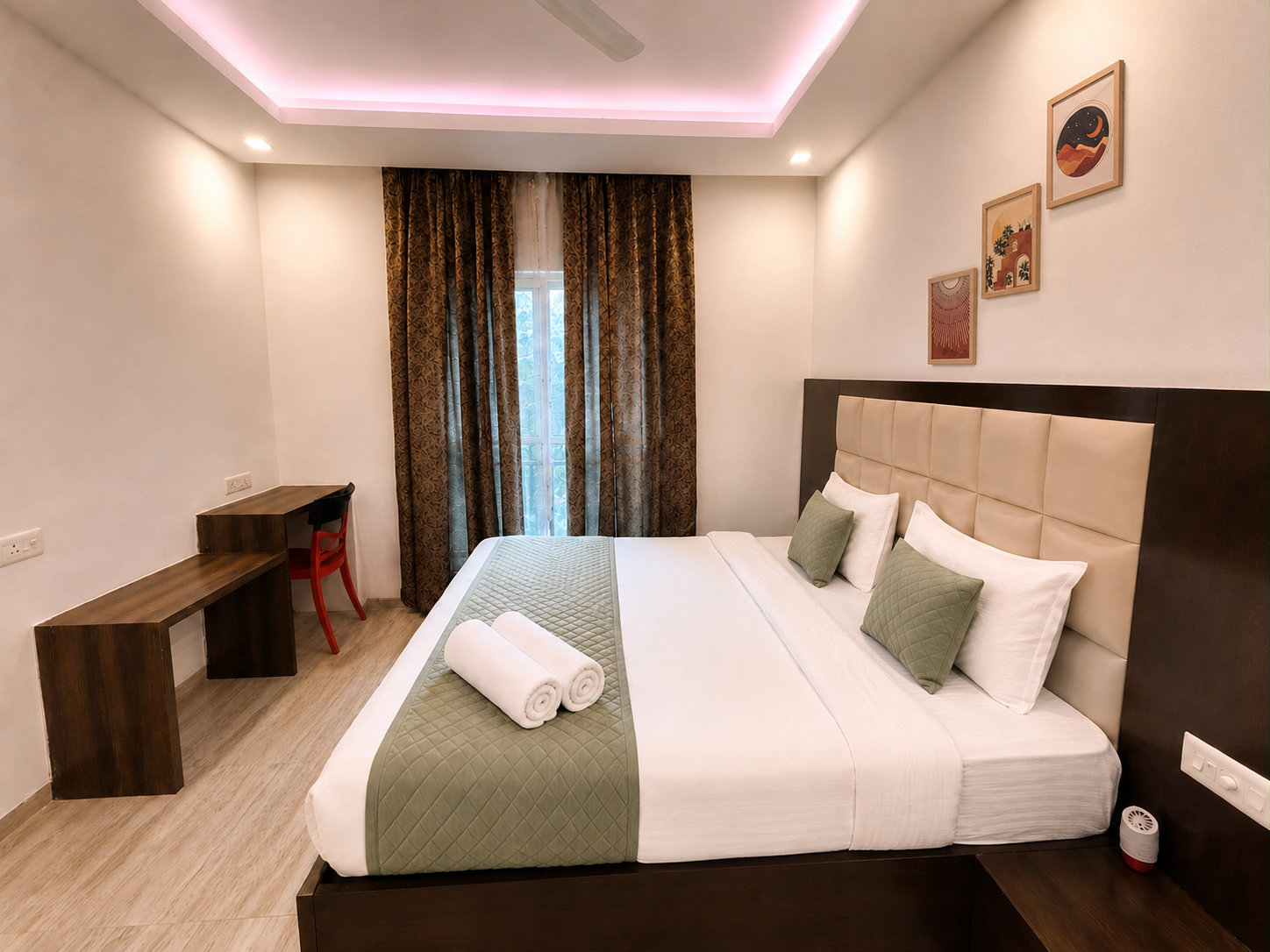
Starting an Airbnb business can look simple from the outside.
Find a property. Furnish it. Take some photos. Upload the listing. Wait for bookings.
That is how it appears.
The reality is that running a successful short-term rental involves property selection, permissions, licences, pricing, guest communication, cleaning, maintenance, photography and dozens of small operating systems.
My husband, Pratik, and I manage short-term-rental properties in Goa through Mango & Moon Hospitality and Bluepalm Stays. Our experience has taught us that a beautiful property may attract attention, but good systems are what protect your reviews and keep the business running.
This guide explains how to start an Airbnb business in India from the beginning—including the decisions people often overlook before publishing their first listing.
Important: This article shares practical experience and general information. Local permissions, society rules, tourism registrations and tax obligations vary. Verify the current requirements for your state and property with the relevant authority and a qualified professional.
Can anyone become an Airbnb host in India?
You do not necessarily need to own a property to become an Airbnb host.
Common hosting models include:
1. Hosting your own property
You list a home, apartment, villa, room or holiday property that you own.
This is usually the simplest structure because you control the property, although society, local and tourism rules may still apply.
2. Leasing a property for short-term rentals
You rent a property from an owner and operate it as short-term accommodation.
This model can work, but you need clear written permission from the owner. A normal residential rental agreement may not automatically permit commercial hospitality use, short stays or subletting.
The agreement should ideally clarify:
- Permission to operate short-term accommodation
- Permission to advertise the property online
- Responsibility for tourism licences and registrations
- Society or building approvals
- Maintenance responsibilities
- Damage and insurance
- Lock-in and notice periods
- Owner-use or complimentary-night arrangements
Do not rely only on a verbal understanding.
3. Co-hosting or property management
You manage another owner’s property and receive either:
- A percentage of revenue
- A fixed management fee
- A combination of both
You may handle listing creation, guest communication, pricing, cleaning coordination and daily operations without taking the property on lease.
Airbnb also operates a Co-Host Network in eligible markets for experienced hosts offering local services, although availability and eligibility can vary.
4. Hosting part of your own home
You may offer a private room, guest suite or portion of your residence.
Depending on the state and accommodation type, this may fall under a homestay or bed-and-breakfast framework.
Is an Airbnb business profitable in India?
It can be profitable, but it is not automatically profitable.
Your results will depend on:
- Monthly rent or property cost
- Average nightly rate
- Occupancy
- Seasonality
- Cleaning and laundry expenses
- Utilities
- Platform charges
- Caretaker and staffing costs
- Repairs and replacement
- Taxes and licence costs
- Marketing and discounting
A property charging ₹4,000 per night is not necessarily more profitable than one charging ₹2,500.
The real question is:
How much remains after every operating cost has been paid?
For example, two hosts may earn the same monthly revenue, but the one with higher rent, excessive maintenance and poor pricing may make far less profit.
Before taking a property, prepare a conservative calculation.
Estimate your monthly revenue
Use:
Expected occupied nights × realistic average nightly rate
Do not calculate using the highest rate visible in your area.
Look at:
- Weekday prices
- Weekend prices
- Monsoon or off-season prices
- Peak-season prices
- Last-minute discounts
- Competitor occupancy
- New-listing discounts
Estimate all expenses
Include:
- Rent or EMI
- Society maintenance
- Electricity
- Wi-Fi
- Caretaker
- Cleaning
- Linen and laundry
- Toiletries
- Platform fees
- Repairs
- Appliance replacement
- Licence and compliance costs
- Accounting
- Guest refunds and emergency purchases
Also maintain a reserve for unexpected expenses.
A blocked drain, damaged lock, faulty AC or last-minute linen replacement can quickly affect the month’s profit.
Step 1: Choose the right market
Do not select a destination only because tourism is popular.
A strong short-term-rental market should ideally have:
- Consistent visitor demand
- Reasonable property rents
- Good road access
- Nearby restaurants and attractions
- Safe surroundings
- Reliable electricity and water
- Available cleaners and maintenance vendors
- Clear local rules
- Demand beyond a single festival or season
Study the market at different times of the year.
Goa, for example, has strong peak-season demand, but monsoon pricing and occupancy can behave very differently. A property that appears highly profitable in December may struggle if the business plan ignores the slower months.
Look at the full year—not only peak dates.
Step 2: Select the right property
A beautiful home is not automatically a good short-term rental.
Before signing, inspect the property as an operator, not merely as a tenant.
Check the location
Ask:
- Can guests find it easily?
- Is the approach road usable at night?
- Is there safe parking?
- Is public transport or taxi access available?
- Are restaurants and essential shops nearby?
- Is the surrounding area noisy?
- Is mobile-network coverage reliable?
Check the building
Confirm:
- Society rules regarding short stays
- Security and guest-entry procedures
- Lift availability
- Parking allocation
- Power backup
- Water-supply system
- Garbage disposal
- Pool-access rules
- Restrictions on parties or visitors
Check the property itself
Test:
- Water pressure
- Hot water
- Taps and flushes
- Door locks
- Balcony locks
- AC units
- Wi-Fi feasibility
- Mobile signals
- Electrical sockets
- Drainage
- Dampness and seepage
- Kitchen appliances
- Natural light
- Noise levels
Spend time at the property during both day and night if possible.
Some problems—poor street lighting, barking dogs, bar noise or difficult access—may not be apparent during a daytime visit.
Step 3: Confirm permissions, registrations and local rules
This is one of the most important steps.
Airbnb provides the platform, but hosts remain responsible for understanding the laws, taxes, permits and business-licence requirements that apply to their properties. Airbnb’s responsible-hosting guidance for India specifically advises hosts to check local regulations, taxation and licensing obligations.
Requirements can vary based on:
- State
- City or village
- Type of accommodation
- Whether the operator owns or leases it
- Whether the host lives on the property
- Number of rooms
- Society or building rules
- Services provided
Goa example
In Goa, tourism accommodation is regulated through state tourism laws and policies. Goa Tourism states that entities or individuals undertaking tourism services must register with the Department of Tourism, and its current homestay and B&B policy requires applicable establishments to register before commencing operations.
Goa Tourism provides separate forms and checklists for categories such as homestays, B&Bs, hotels and guest houses.
Do not assume that uploading an Airbnb listing automatically completes these requirements.
Documents you may need
Depending on the local authority and accommodation category, you may be asked for some combination of:
- Ownership document or registered lease
- Owner’s NOC
- Society or association NOC
- Property-tax receipt
- Identity and address proof
- Property plan
- Fire-safety documentation
- Electricity bill
- Photographs
- Police or local-authority clearances
- Tourism-registration application
- Business-registration details
Check the exact current list with the relevant department.
Step 4: Decide your business structure
You may operate as:
- An individual
- A sole proprietorship
- A partnership
- An LLP
- A private limited company
- A property-management or co-hosting service
The right structure depends on:
- Who owns or leases the properties
- Number of partners
- Turnover
- Liability
- Taxation
- Whether you manage other owners’ properties
- Future expansion plans
For a single small property, some hosts begin individually or through a proprietorship.
As operations expand, a more formal structure may make accounting, contracts and business separation easier.
Consult a chartered accountant before deciding, especially when you operate leased properties and owner-managed properties under different revenue models.
Step 5: Understand GST and income-tax responsibilities
Tax treatment depends on your turnover, business structure, property model and applicable rules.
Airbnb advises Indian hosts to provide their PAN so that the appropriate withholding treatment can be applied.
Airbnb’s India GST guidance states that hosts expecting annual commercial turnover above the applicable registration threshold—generally ₹20 lakh for services, or ₹10 lakh in specified special-category states—may be liable to register for GST.
CBIC’s published GST guidance also describes the general service-provider registration threshold as ₹20 lakh, with ₹10 lakh applying in relevant special-category states, subject to exceptions and current law. (Source: CBIC)
However, GST questions can become more complex when:
- You have multiple businesses
- You operate in more than one state
- You receive platform payments
- You manage properties for other owners
- You provide additional taxable services
- You cross the threshold during the year
Do not rely on a blog article alone for tax decisions. Obtain advice based on your exact structure.
Keep proper records of:
- Booking income
- Platform deductions
- Direct-booking payments
- Deposits and refunds
- Rent
- Utilities
- Cleaning expenses
- Repairs
- Salaries and vendor payments
- Furniture and appliance purchases
- Marketing expenses
Clean bookkeeping from day one is far easier than reconstructing transactions later.
Step 6: Calculate your setup budget
Your budget will depend on whether the home is:
- Fully furnished
- Partly furnished
- Completely empty
- Premium or budget positioned
Typical setup categories include:
Bedroom
- Mattress
- Mattress protector
- Bed linen
- Pillows
- Pillow protectors
- Comforter
- Extra blanket
- Bedside lamps
- Curtains
- Hangers
- Luggage space
- Full-length mirror
Bathroom
- Towels
- Hand towels
- Bathmats
- Buckets and mugs, where appropriate
- Shampoo
- Body wash
- Hand wash
- Toilet paper
- Dustbin
- Geyser
- Exhaust or ventilation
- Basic cleaning products
Kitchen
- Refrigerator
- Induction or gas arrangement
- Microwave, if relevant
- Kettle
- Water purifier
- Cookware
- Plates and bowls
- Cups and glasses
- Cutlery
- Serving utensils
- Dustbin
- Cleaning supplies
Living room
- Comfortable seating
- Coffee table
- Smart TV
- Wi-Fi router
- Curtains
- Lighting
- Functional décor
- Dining arrangement, where possible
Operations
- Spare keys
- Lockbox
- Cleaning tools
- Linen stock
- Inventory storage
- Fire extinguisher
- First-aid kit
- Emergency lights
- Signage and instructions
Do not spend only on décor while ignoring practical items.
A beautiful vase may improve a photograph.
A spare key may save an entire stay.
Step 7: Make the property guest-ready
There is a major difference between furnished and guest-ready.
Before photographing or listing the property, stay there yourself for at least one night if possible.
Use everything as a guest would.
Check:
- Can you open every lock easily?
- Is hot water available?
- Does the Wi-Fi work in every room?
- Are there enough charging points?
- Is the mattress comfortable?
- Is the kitchen genuinely usable?
- Are instructions required for any appliance?
- Is the property easy to locate after dark?
- Is the water supply reliable?
- Is the TV logged into appropriate apps?
- Is the room dark enough for sleeping?
- Are there insects, smells or drainage problems?
Our own experience has repeatedly shown that guests can struggle with things that appear obvious to the host.
A lock you use every day may be confusing to someone seeing it for the first time.
A Wi-Fi router may work perfectly in the living room but fail in a bedroom.
Test the property from the guest’s perspective, not yours.
Step 8: Take high-quality listing photos
Photos are among the strongest factors influencing whether someone opens and considers your listing.
You do not necessarily need expensive equipment, but you do need:
- Good natural light
- Clean rooms
- Straight lines
- Wide, honest angles
- Consistent editing
- No unnecessary clutter
- Accurate colours
- Clear exterior and access photos
Prepare before shooting
- Remove cleaning supplies
- Hide loose wires
- Straighten curtains
- Dry bathroom floors
- Remove stains and marks
- Arrange cushions
- Clear kitchen counters
- Clean mirrors
- Check visible spider webs
- Switch on appropriate lights
- Remove personal items
Photographs reveal details that may be easy to miss while standing in the room.
Zoom into every image before publishing it.
Show the entire experience
- Living room
- Bedrooms
- Bathrooms
- Kitchen
- Balcony
- Pool or common areas
- Building exterior
- Parking
- Entrance
- Work desk
- Views
- Important amenities
Do not hide limitations.
Accurate listings create better expectations, and Airbnb’s host ground rules require listing accuracy, cleanliness, timely communication and honouring reservations.
Step 9: Create your Airbnb account and listing
Airbnb allows prospective hosts to create a home listing through its hosting platform. According to Airbnb, getting started is free, hosts set their prices, and platform fees are collected after the host is paid.
Airbnb may ask hosts to complete identity, address and KYC-related verification. Its India guidance mentions information such as legal name, address and government-issued documentation, including PAN or passport in relevant verification processes.
Write a clear title
A strong title should communicate:
- Property type
- Location
- Major selling feature
- Nearby landmark, when genuinely close
Examples:
- Peaceful 2BHK in Siolim with Pool
- Family-Friendly 2BHK near Vagator
- Pool-View Apartment near Assagao
Do not misrepresent distance.
Write the description around the guest
Avoid describing only furniture.
Instead of:
The apartment has two bedrooms, a sofa and a balcony.
Write:
Wake up to a quiet green view, enjoy breakfast on the balcony and reach some of North Goa’s popular cafés and beaches within a short drive.
Explain:
- Who the property suits
- Atmosphere
- Layout
- Work suitability
- Nearby areas
- Parking
- Pool access
- Stairs or lift
- Noise
- Check-in process
- Any limitations
Complete the amenities carefully
Guests often filter listings by amenities.
Confirm every selected amenity exists and works.
Do not select:
- Dedicated workspace when it is only a dining chair
- Free parking when parking is uncertain
- Pool when access is restricted
- Washer when it is not guest-accessible
- Power backup if only a few lights work
Accuracy protects trust.
Step 10: Price the property realistically
Do not copy the highest-priced competitor.
Compare properties based on:
- Same neighbourhood
- Similar bedroom count
- Similar amenities
- Comparable quality
- Review count
- Pool availability
- Parking
- Building condition
- Distance from attractions
Build a pricing structure
Create separate rates for:
- Weekdays
- Weekends
- Long weekends
- Festivals
- Peak season
- Off-season
- Last-minute dates
- Longer stays
When your listing is new, the lack of reviews may make guests hesitant.
An introductory price can help generate early bookings, but do not discount so heavily that you attract unsuitable bookings or make operations unviable.
Track:
- Views
- Enquiries
- Booking conversion
- Average nightly rate
- Occupancy
- Length of stay
- Lead time
- Revenue after discounts
Pricing is an ongoing experiment, not a one-time decision.
Step 11: Build the guest journey
A good stay begins before arrival.
Map every stage:
Before booking
Guests need:
- Accurate photos
- Clear description
- Transparent rules
- Quick answers
After booking
Send:
- Booking confirmation
- Property details
- ID requirements
- Check-in time
- Location
- Contact information
Before arrival
Confirm:
- Arrival time
- Guest count
- IDs
- Parking needs
- Lockbox or key instructions
- Caretaker contact
During the stay
Provide:
- Wi-Fi details
- Appliance instructions
- House rules
- Emergency contacts
- Local recommendations
- A way to report problems quickly
Before checkout
Send:
- Checkout time
- Key-return instructions
- Basic departure guidance
- Thank-you message
Communication should be clear enough for someone who has never visited the building before.
Step 12: Create cleaning and turnover systems
Do not depend only on verbal instructions.
Create a written checklist.
It should cover:
Bedroom
- Fresh linen
- Clean pillow covers
- Mattress check
- Towels placed
- Dust removed
- Bed inspected for stains or damage
- Drawers checked
- Curtains arranged
Bathroom
- Toilet sanitised
- Sink cleaned
- Mirror cleaned
- Floor dry
- Drain checked
- Hot water tested
- Toiletries refilled
- Bin emptied
- No hair visible
Kitchen
- Sink cleaned
- Refrigerator checked
- Utensils arranged
- Appliances tested
- Water purifier checked
- Counter dry
- Dustbin emptied
Living room
- Sofa checked
- TV tested
- Remote present
- Wi-Fi tested
- Balcony cleaned
- Glass doors checked
- Décor arranged
Final inspection
- Water running
- AC working
- Lights working
- Wi-Fi connected
- No garbage
- No odour
- Keys available
- Door locks tested
- Photos taken after cleaning
Photographic proof is particularly useful when you manage remotely.
Step 13: Prepare for emergencies
Unexpected problems will happen.
Your goal is not to eliminate every problem.
Your goal is to respond quickly and calmly.
Create a contact list for:
- Caretaker
- Cleaner
- Watchman or security
- Plumber
- Electrician
- AC technician
- Internet provider
- Appliance technician
- Owner
- Society manager
Maintain backups for:
- Keys
- Linen
- Toiletries
- Emergency lights
- Wi-Fi data
- Water supply, where practical
- Cleaning staff
- Maintenance vendors
One of our guests once messaged us at 12:19 AM saying there was no water at the property.
We replied immediately, started checking the issue and went to the property when it could not be resolved remotely.
The water was restored, and by 12:53 AM we could tell the guest:
“The water is back.”
That incident reinforced an important lesson:
A host does not need to know every answer immediately. But the guest must know that somebody is taking responsibility.
Step 14: Collect reviews honestly
Do not buy reviews or pressure guests.
Earn them through:
- Accurate expectations
- Cleanliness
- Fast communication
- Smooth check-in
- Working amenities
- Responsible problem-solving
After checkout, leave a fair review and politely invite the guest to share feedback.
Pay attention to patterns.
One complaint may be personal preference.
Repeated comments about Wi-Fi, directions, cleanliness or a lock indicate a system problem.
Reviews should help you improve—not merely validate the listing.
Step 15: Track the business like a business
Maintain a monthly sheet containing:
- Booking source
- Guest name
- Check-in and checkout
- Nights
- Gross revenue
- Platform fee
- Cleaning fee
- Discounts
- Net payout
- Electricity
- Laundry
- Caretaker cost
- Repairs
- Supplies
- Monthly profit
Also track performance by property.
A busy property is not always the most profitable one.
Your data should help you decide:
- Whether to increase or decrease pricing
- Which dates remain unsold
- Which platform performs best
- Which property has excessive maintenance
- Which expenses can be controlled
- Whether expansion is sensible
Common mistakes new Airbnb hosts make
1. Assuming hosting is passive income
Even with a caretaker, the host remains responsible for standards, communication and decision-making.
2. Taking an expensive property based on peak-season rates
Calculate performance across the complete year.
3. Starting without written owner permission
This can create serious disputes later.
4. Ignoring local registrations
Platform approval does not replace government, tourism or society requirements.
5. Spending on décor but not operations
Prioritise mattresses, locks, water, Wi-Fi, linen and cleaning systems before decorative items.
6. Using poor or misleading photos
Great photographs attract bookings. Misleading photographs attract disappointment.
7. Copying competitors’ prices blindly
Their rent, quality, reviews and business objectives may be completely different.
8. Having only one emergency contact
Always maintain backups.
9. Writing vague check-in instructions
Test directions with someone unfamiliar with the property.
10. Expanding before the first property is stable
Build reliable systems before adding more inventory.
Frequently asked questions
Can I start an Airbnb business without owning property?
Yes, hosts may operate leased properties or manage properties for owners. However, you need a legally suitable agreement, clear owner permission and compliance with local, society and tourism requirements.
How much money is required to start?
There is no fixed amount.
The cost depends on:
- Security deposit
- Rent
- Furnishing level
- Property size
- Existing appliances
- Linen
- Photography
- Registration
- Initial working capital
Prepare both a setup budget and at least a few months of operating reserves.
Do I need a tourism licence?
The answer depends on your state, local authority and accommodation category.
For example, Goa regulates tourism accommodation through its Department of Tourism, with registration requirements applying to relevant tourist accommodation and homestay/B&B operations.
Check your local rules before opening.
Do Airbnb hosts need GST registration?
GST registration depends on applicable thresholds, turnover, structure and other circumstances. Published guidance describes a general ₹20 lakh service threshold, with ₹10 lakh applying in specified special-category states, but exceptions and special situations may apply. Consult a chartered accountant.
Can foreigners stay in my property?
Yes, but hosts should understand applicable guest-record and foreign-national reporting requirements. Airbnb’s India guidance notes practices such as collecting valid government ID and, for foreign nationals, passport and visa details, together with any required visitor registration or reporting.
Verify the current FRRO/Form C and local police requirements applicable to your accommodation.
Is Airbnb passive income?
Not in the beginning.
Systems can reduce daily involvement, but somebody must remain accountable for:
- Guest communication
- Cleaning
- Maintenance
- Pricing
- Emergencies
- Compliance
- Quality control
How long does it take to get the first booking?
There is no guaranteed timeline.
It depends on:
- Demand
- Pricing
- Photos
- Reviews
- Location
- Availability
- Competition
- Listing quality
A new listing may receive bookings quickly in a strong market, or take longer in a slower or highly competitive location.
Should I list only on Airbnb?
Airbnb can be a strong starting platform.
As the business matures, you may consider:
- Other OTAs
- Your own website
- Direct enquiries
- Repeat guests
- Social-media advertising
However, direct bookings require secure payment processes, proper confirmation, cancellation policies and reliable recordkeeping.
Final thoughts on how to start an Airbnb business in India
Starting an Airbnb business is not only about creating a listing.
It is about building a hospitality operation.
The property must be attractive enough to win the booking.
The systems must be strong enough to deliver the stay.
The most successful hosts are not necessarily those with the most expensive homes.
They are the hosts who consistently manage the small details:
- Clean rooms
- Clear communication
- Fair pricing
- Reliable utilities
- Easy check-in
- Fast problem-solving
Guests see the finished stay. Hosts see everything it took to create it.
That is The Host Side. And that is how to start an Airbnb business in India the right way—one system at a time.
About the authors
Heena Israni and Pratik Singh are short-term-rental operators based in Goa, India. Together, they manage hospitality properties through Mango & Moon Hospitality and Bluepalm Stays.
The Host Side documents their real hosting experiences, operational systems, property lessons and everything that happens behind a smooth five-star stay.
Independence and legal disclaimer
The Host Side is an independent publication and is not affiliated with, sponsored by or endorsed by Airbnb, Inc. Airbnb is a registered trademark of its respective owner.
The information in this article is general and educational. Regulations, taxes, licences and business requirements vary by state, city, property and operating model. Obtain current guidance from the relevant authorities and qualified legal, accounting and tax professionals.